By
Tad Sooter
Posted April 20, 2014 at 5:19 p.m.
BAINBRIDGE ISLAND — A familiar bakery and a new tavern are among the
businesses setting up shop this spring on Bainbridge Island’s busiest
street corner.
Contractors are putting finishing touches on the last building in the
Island Gateway development at Winslow Way and Highway 305. Interior
finish work, driveway paving, landscaping and signage are all that
remain to complete the five-year project, said Andrew Lonseth of
development firm Asani.
 |
Andrew Lonseth talks about lights to
illuminate the Eagle Harbor Market sign that is part of the Island
Gateway development at Winslow Way and Highway 305.
|
Island Gateway already is home to the Bainbridge Island Museum of
Art, Kids Discovery Museum and tech firm Avalara. The final two-story
building on Winslow Way is filling fast.
Bainbridge Bakers, a popular café in Winslow Green, will open a
second location this week on the ground floor. The bakery will be joined
in late June by the Ale House on Winslow, a planned craft beer taproom.
Avalara expanded into the top floor of the building. A rooftop event
deck will be available for rent.
 |
Photo by Meegan M. Reid, Kitsap Sun
Andrew Lonseth exits the rooftop Thursday of the Island Gateway development on Bainbridge Island.
|
One street-front retail space in the building remains to be filled.
Lonseth said he is in discussions with several potential tenants but
nothing has been finalized.
“We’d like a tenant that brings interest and excitement,” Lonseth
said. “It’s important to us that we have a destination community.”
Bainbridge Bakers owner Mike Loudon said he’d had his eye on the
corner location since well before the Gateway project broke ground.
“It’s the realization of a pretty long dream,” Loudon said Friday.
The new Bainbridge Bakers has seating for 85. Like the original
location, it serves coffee, baked goods and food. Beer and wine will be
added to the mix later this year.
The café also can double as a venue for theatrical and musical
performances. Loudon, an avid community theater booster, said seating
can be rearranged to accommodate 150 guests.
“I’m so excited about having it filled with music and people and
light,” he said. “It’s going to be something pretty special for the
island.”
Bakery customers might well mosey next door after those evening
performances. The neighboring Ale House on Winslow aims to fill a niche
as a craft beer taproom and late-night hangout.
 |
Photo by Meegan M. Reid, Kitsap Sun
Andrew Lonseth talks Thursday about the remaining
construction to take place in the space that will house the Ale House
on Winslow in the Island Gateway development on Bainbridge Island.
|
Travis Samson, one of four partners in the venture, said the Ale
House will be outfitted with 16 taps and a wide variety of bottled beer
and wine. They plan to stock a large number of local brews, alongside a
sampling of domestic brands and a few imports.
“I’d like to make Bainbridge more of a destination for beer geeks,”
Samson said. “Our overall goal is to have a beer there for everyone,”
Samson, 27, worked at Silver City Brewery before deciding to go into
business with a group of college friends. They still have ambitions to
start a microbrewery in Seattle, but Samson said the chance to create a
tavern in the Island Gateway was too good to pass up.
 |
Photo by Meegan M. Reid, Kitsap Sun
The Ale House on Winslow sign Thursday adorns one
of the windows of the Island Gateway development at Winslow Way and
Highway 305.
|
“It’s literally the first thing you’ll see coming off the ferry,” he said.
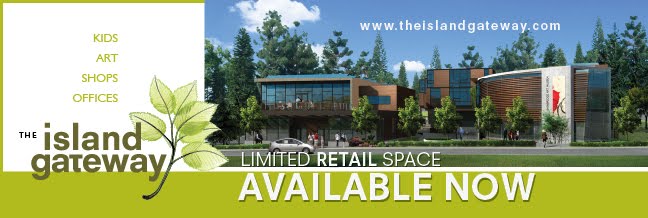
The Gateway project rapidly transformed the island’s main entry over
the past five years, filling the 5-acre corner with a cluster of
distinctly modern structures.
The final building in the development was constructed on the site of
the Eagle Harbor Market, a small grocery opened by the Nakata family in
the 1940s. The new Gateway building now bears the same name.
“It’s a little historical gesture,” Lonseth said.


 He
scouted the location several years ago, before the striking art museum
transformed the corner across from the Bainbridge Island ferry. Mike
Loudon had his eye on the developing Island Gateway complex and the
building that was already there, partly occupied by Avalara, for a
possible second location for his business, Bainbridge Bakers.
He
scouted the location several years ago, before the striking art museum
transformed the corner across from the Bainbridge Island ferry. Mike
Loudon had his eye on the developing Island Gateway complex and the
building that was already there, partly occupied by Avalara, for a
possible second location for his business, Bainbridge Bakers.